
On March 11th and, due to incredible demand, also on March 20th, 2025, the Vancouver Division’s Seniors and Frail Elder Care Committee hosted the “Improving Seniors’ Care: Interactive Case Discussions” events. These collaborative case study-focused sessions highlighted care pathway development, supporting physicians in caring for their frail seniors living in the community. These events were the third and fourth in the Partners in Care Series - the first was in March 2024 and concentrated on navigating resources for frail seniors, and the second was in October 2024 and focused on elder abuse, neglect and self-neglect. The resources from our previous sessions are available at
- Partners In Care: Navigating Resources for Frail Seniors
- Partners In Care: Preventing & Responding to Abuse, Neglect and Self-Neglect
A PDF which lists the table cards detailed information and has links to all resources are available here.**
Case Studies & Care Pathways
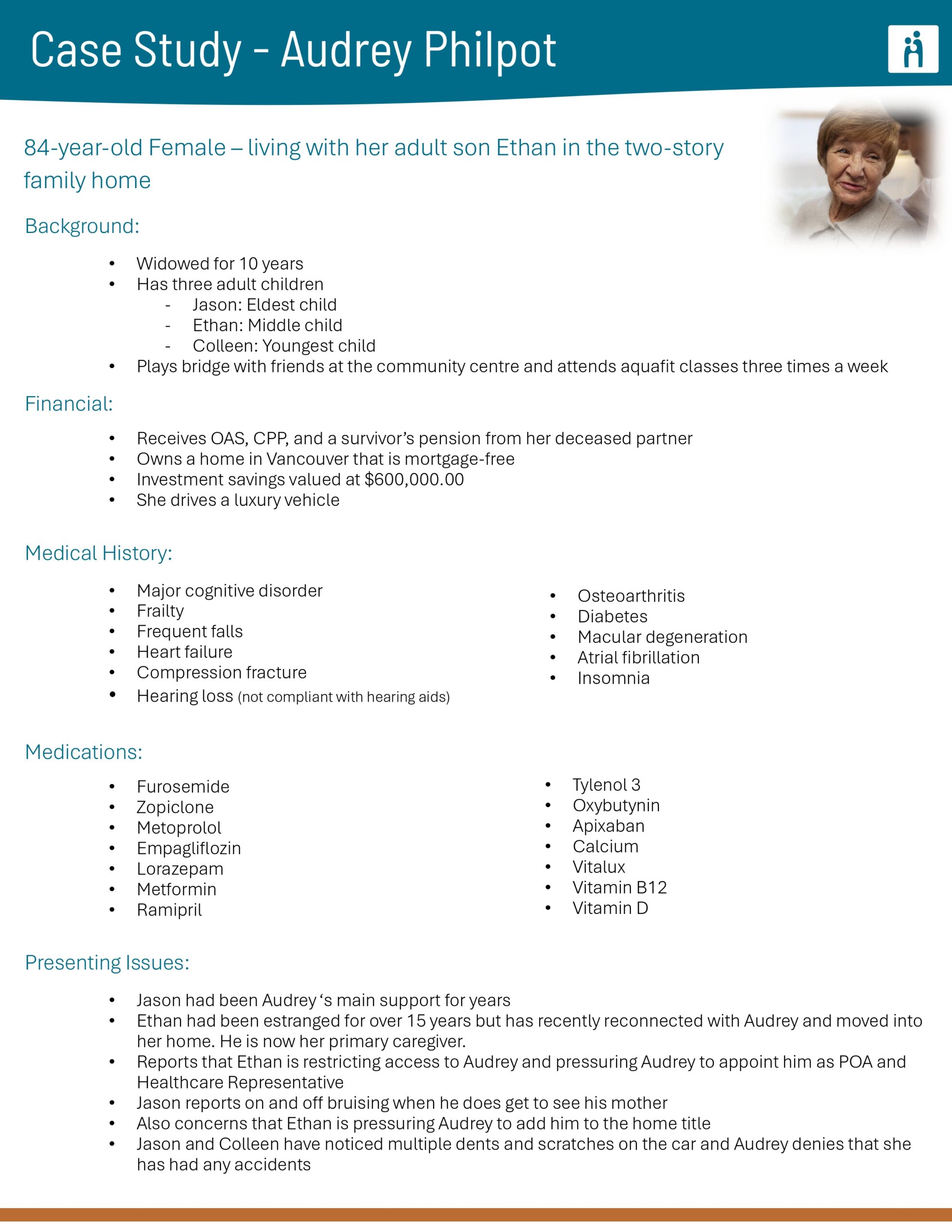
Case Study - Audrey Philpot (Downloadable PDF)
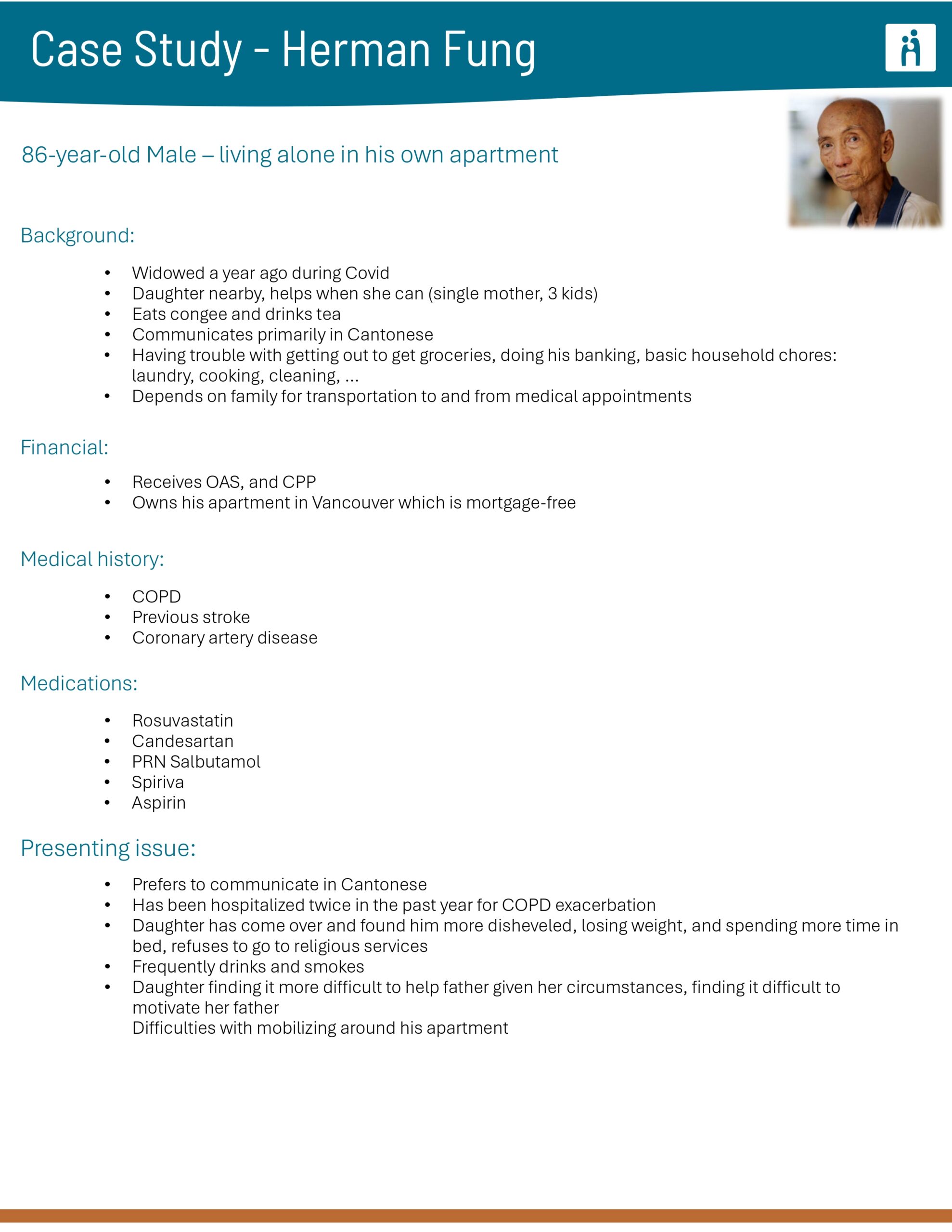
Case Study - Herman Fung (Downloadable PDF)
Event Resources
Did you miss the event, or need a refresher? You can view helpful resources from the event below
Case Study Workflow
As part of the event, participants engaged in an interactive activity utilizing a series of issue cards designed to facilitate discussion and problem-solving around key challenges faced by individuals in need of support. These cards were instrumental in guiding conversations, encouraging critical thinking, and fostering collaboration among attendees. Participants then created their own care plans using the "Tools / Assessment Cards" and the "Support Service / Resources Cards" listed below.
Issue Cards
The following issue cards were used in the activity to help participants identify and address various concerns:
- Dementia
- Frailty
- Depression
- Goals of Care
- Driving
- Falls
- ADLs/iADLs (Activities of Daily Living / Instrumental Activities of Daily Living)
- Social Isolation
- Polypharmacy
- Caregiver Burnout
- Declining Physical/Mental Capacity
- Financial Instability
- Capacity
Resource Card List
A basic guide for families to help orient themselves as their loved ones go through the various stages of frailty
Outlines the features of each stage, includes questions to clarify where they are and what’s to come, has links to other resources, and has suggestions about the things they can do as a family and care team to give the patient the best quality of life
AKA – Mini Mental State Examination
A brief, quantitative measure of cognitive status in adults
Tests five areas of cognitive function: orientation, registration, attention and calculation, recall, and language
5-10 minute assessment time
A guide to talk to substitute decision makers about; setting up a conversation, assessing understanding, sharing prognosis, exploring key topics, closing and documenting the conversation, and communicating with key care team members
A basic guide for families to help orient themselves as their loved ones go through the various stages of dementia
Outlines the features of each stage, includes questions to clarify where they are and what’s to come, has links to other resources, and has suggestions about the things they can do as a family and care team to give the patient the best quality of life
AKA – Patient Health Questionnaire-9
A multipurpose self report instrument for screening, diagnosing, monitoring and measuring the severity of depression
Rates the frequency of the symptoms which factors into the scoring severity index
2-5 min assessment time
A self-report measure of depression in older adults
A questionnaire in which participants are asked to respond by answering yes or no in reference to how they felt over the past week
Short form version: 15- items selected from the long form version which had the highest correlation with depressive symptom
5-7 min assessment time
RoadsafetyBC requires medical and nurse practitioners to report any patient who has a medical condition that makes it dangerous for them to drive, and continues to drive after you’ve warned them not to
Reports may result from a condition causing persistent functional impairment or a condition that may cause episodic incapacitation
AKA – Medical Orders for Scope of Treatment
An order completed by the adult’s Most Responsible Practitioner (MRP)
Identifies one of six designations that provides direction on resuscitation status and scope of critical care and medical interventions
A self-report measure to assess the risk of falling in older adults
2-5 min assessment time
AKA – Elder Abuse Suspicion Index
A screening tool to detect those who are victims of elder abuse
Aims to raise the level of suspicion about elder abuse to make an in-depth exploration about possible mistreatment, or ask patient permission to refer them for specialized evaluation by social service workers, adult protection workers, or specially trained police
AKA – Screen for the Identification of the cognitively Impaired Medically At-Risk Driver
A screening tool for the identification of cognitively impaired medically at-risk drivers
Developed and validated against actual driving performance using a driving evaluation
Tests general cognitive function specifically assesses working memory, visual processing, visuospatial skills, selective and divided attention, processing speed, and psychomotor coordination
Used in screening for driving fitness
2-5 min assessment time
Aims to improve the care of older adults living with frailty and support their families and caregivers by increasing recognition and assessment of frailty, increasing evidence for decision making, advancing evidence-based changes to care, educating the next generation of care providers, and by engaging with older adults and caregivers
Help to identify inappropriate or unnecessary medications to discontinue them through deprescribing guidelines and algorithms, patient decision aids, and an up-to-date resource list of evidence and research
A guide to talk to patients about; their goals and values, setting up a conversation, assessing the patient’s illness understanding and information preferences, sharing prognosis, exploring key topics, and closing and documenting the conversation
AKA – Montreal Cognitive Assessment
A highly sensitive tool for early detection of mild cognitive impairment
Assesses different cognitive domains: attention and concentration, executive functions, memory, language, visuoconstructional skills, conceptual thinking, calculations, and orientation
10 minute assessment time
A scale that measures the various stages of frailty and highlights the associated limitations to daily life as frailty progresses
A user-friendly frailty assessment method that requires no training or instruction
Based on the Frailty Assessment for Careplanning (FACT) tool and is designed to reliably assess frailty in as few questions as possible
A multidimensional holistic assessment, which considers health and wellbeing and formulates a plan to address issues which are of concern to an older person and their family, arranges interventions according to the plan, and then reviews the impact
AKA – Advanced Care Planning
A guide to prepare patients for future health care decisions by exploring their values, beliefs, goals, and preferences, help patients decide on a surrogate decision maker (SDM), and engage the SDM in the ACP process
Provides specialized community-based mental health and substance use services for older adults
Typically for those 65 years and older enduring mental illness and/or substance use disorder and the coexistence of impairments in multiple domains related to the aging process
VCH Allied Health Professionals and Community Primary Care Providers working together to support patients wholistically
Free for attached patients who do not have access to extended health benefits or other means of access to funded health supports, one referral form for all services, care conferences with IPT
Clinicians, internal referral to other IPT health providers, focus on mild to moderate health care needs
A referral form to arrange home and community care services
Access line numbers cover various sectors throughout BC
Home health services, case managers, orders, and treatment plans available through form
Some home and community care services are provided free of charge, others include a fee determined by income
AKA – Public Guardian and Trustee of BC
Protects the legal, financial, personal, and health interests of adults who require assistance in decision making
When a referral about a vulnerable adult in the community is received, PGT will research, ask many questions and help find the best solution to support the person that is vulnerable
A range of palliative and end-of-life support and services offered by VCH for people living with serious illness, including their families, loved ones, and caregivers
The palliative or end-of-life services include options for, in home, in hospital, in long term care, in hospices, and through outpatient clinics and programs
A provincial, not-for-profit that provides physical and/or emotional care to those who support a family member, friend, or neighbor
Supports caregivers by providing access to information, education and supports
Provides direct support to caregivers through one-on-one emotional support, caregiver support groups, health care system navigation, and free educational resources
A non-profit agency providing local and provincial programs and services to support vulnerable older adults to live as independently as possible
Connects adults 60+ with individual supports, social, meal, transport, community education and housing navigation services to enhance their lives
A non-profit, charitable organization that provides education on personal planning
Operates a centralized Registry for personal planning documents, including Representation Agreements, Enduring Powers of Attorney, Advance Directives, My Voice Expression of Wishes, Nominations of Committee and Notices of Revocations.
A program that helps older adults with simple non-medical, day-to-day tasks so that they can continue to live independently in their own homes and remain connected to their communities
Services vary from community to community but could include friendly visiting, transportation, light yard work, minor home repairs, light housekeeping, grocery shopping, and snow shoveling
Receives reports, provides consultation and coordinates responses to abused, neglected and self-neglected adults who cannot seek support and assistance on their own
Referrals are responded to in accordance with the Adult Guardianship Act which gives VCH enhanced powers to intervene in emergencies and investigate situations where vulnerable adults are living at risk
AKA – Seniors Abuse & Information Line
A province-wide helpline for older adults and those concerned about older adults
Provides general information and referral to community and/or government supports
Provides information about abuse and neglect, including identifying potential risk and escalation
Conducts intake into Seniors First BC programs
VCH provided specialized service for frail seniors and adults with physical or cognitive challenges who live independently in the community by themselves or with a caregiver
Participants are provided with transportation, medical supervision, outings, activities, breakfast, lunch, snacks, and take-home meals
Participants must be referred by a VCH case manager
A free and confidential service that connects people to non-emergency helpful and vital resources in their community
Provides information and referral to a broad range of community, government, and social services that assist with; basic needs like food and shelter, mental health and addictions support, legal and financial assistance, and support for seniors and newcomers
Supports organizations to provide services to their diverse clients, including immigrants, refugees, official minority language speakers and members of the Deaf, Deaf-Blind and Hard of Hearing community through addressing language and communication access issues and barriers
Services provided include; interpreting, deaf, deaf-blind & hard of hearing, francophone, translation
Work alongside a multidisciplinary diverse team of health care professionals in general practice and within the primary care network, providing primary support for prescription and medication queries
Reviews and make recommendations for the ongoing needs of patients
Manages the use of medications with unplanned hospital admissions and with high-risk patient groups
A door-to-door, shared-ride service for persons who have either a temporary or permanent, physical or cognitive disability that is sufficiently severe that they are unable, without assistance, to use conventional transit for part or all of their travel